
Utility Co-op - Peak Time - Living (if you can call it that) 1 of 2

Updated: Jul 14, 2025
As this is my first blog post, I asked the AI Title Creator to give me options for the title. Here's what it offered: "Maximizing Savings with Utility Co-op Peak Time Living Strategies", "Maximizing Benefits of Utility Co-op Peak Time Living Strategies".
I want to say up-front, that although there are savings if you adhere to not using ANY energy during the "peak time", your quality of life is significantly restricted. You are constantly watching the clock (3pm-6pm in the summertime and 6am-9am in the wintertime) to make sure you don't wash clothes, run the dryer, take a shower, or cook anything. The co-op's suggestion for cooking is to use the microwave during peak time which is the least healthy option you can do (a topic for another day)!
On top of the fact that, because you can't start cooking in the summer until after 6pm, you are now eating later which isn't healthy either. And in the mornings during the winter, when nutrition is especially important due to limited sunlight, you have to feed your kids sugary cereal instead of a good breakfast.
NEWS FLASH: The utilities are now controlling your life if you can't afford to pay the HUGE electric bill you will incur by doing the healthy things during "peak" time. So, how do you win against the giant corporate utilities?
First, we need to look at the kWh usage is are for the appliances you use for different activities. I asked Grok 3 from xAI to provide this information.
Per Grok: "Below is a table estimating the kilowatt-hour (kWh) usage per hour for the specified appliances. These values are approximate, as actual consumption varies based on appliance efficiency, model, settings, and usage patterns. Where applicable, I’ve used typical wattage ranges from recent data and calculated kWh (wattage ÷ 1000 = kWh per hour). For HVAC, assumptions are made for a standard 2,000 sq. ft. home with a 3-ton unit, and water heater estimates assume electric tank models."
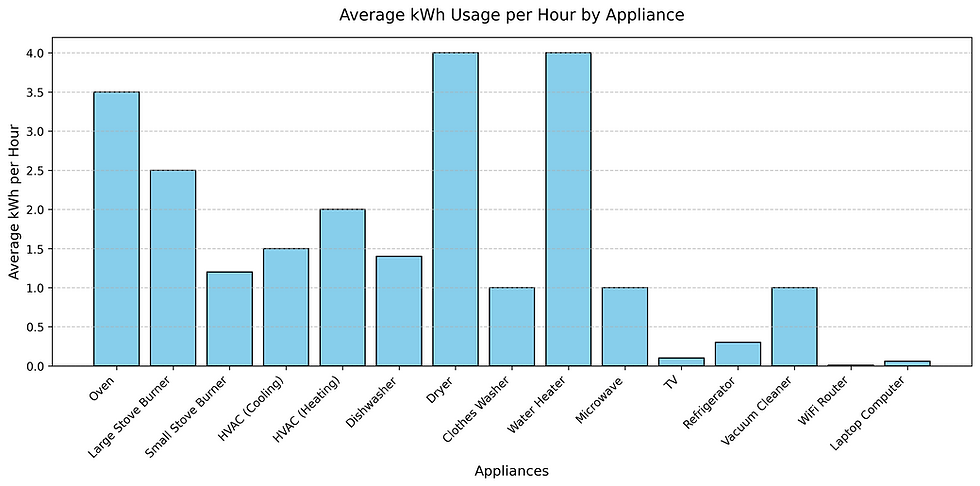
Notes:
Oven and Stove Burners: Usage depends on temperature settings and burner size. Averages assume moderate use.
HVAC: Cooling/heating 1°F includes initial adjustment and maintenance. Values vary by climate, insulation, and system efficiency (e.g., SEER rating for cooling, COP for heating). Heating typically consumes more energy.
Dishwasher/Dryer/Washer: Assumes full cycles; energy-efficient models use less.
Water Heater: Assumes continuous operation for an hour; actual usage depends on hot water demand.
Refrigerator: Varies by size and age; modern Energy Star models are lower.
Vacuum, Microwave, TV: Usage depends on settings and runtime.
WiFi Router/Laptop: Low-energy devices; consumption is minimal but continuous for routers.
Using the information above, we will now explore the costs associated with using these appliances during "Peak Time".
Comments